
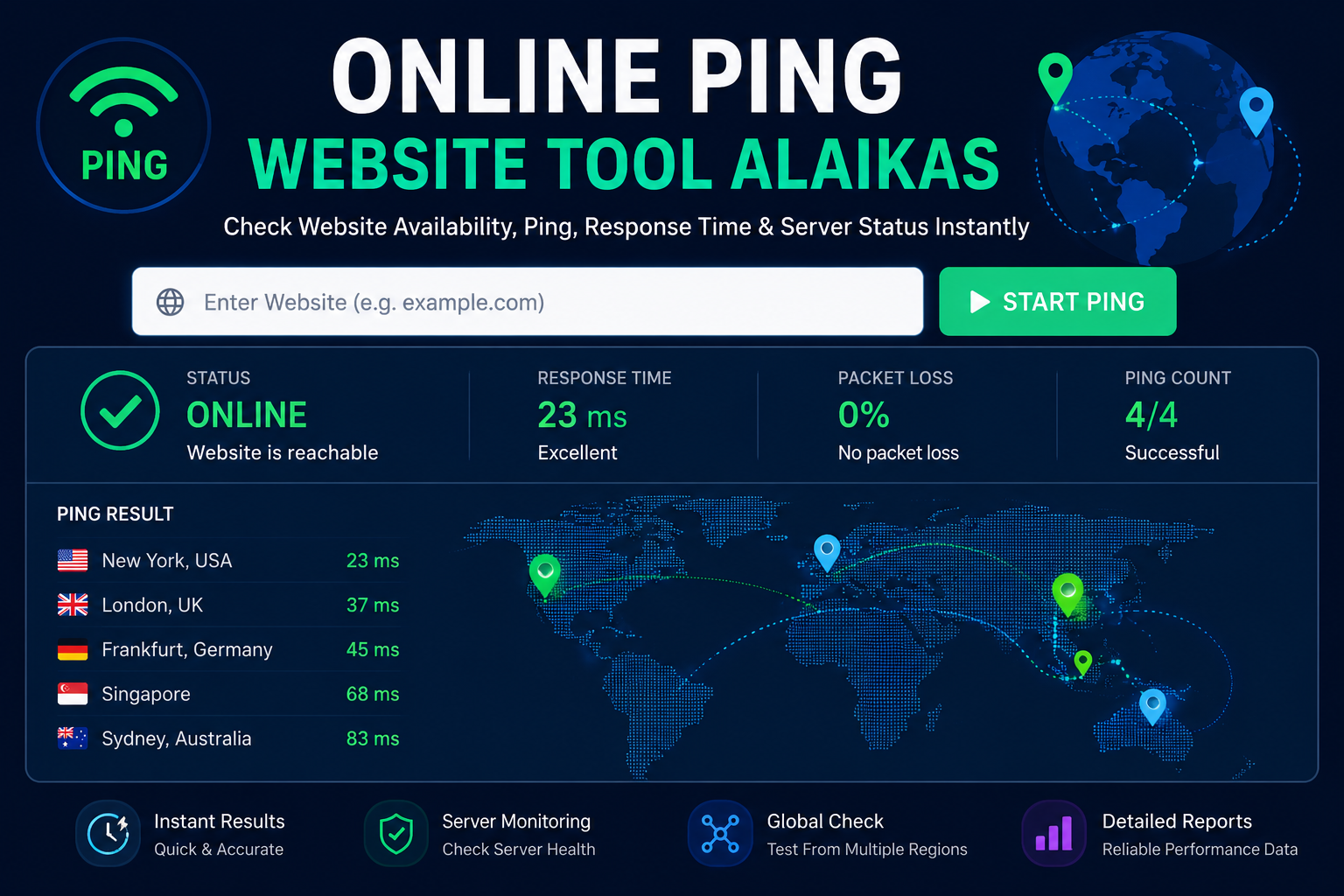
The internet depends on fast communication between users, servers, and websites. When a website loads slowly or becomes unavailable, even for a short period, visitors notice immediately. Businesses lose potential customers, blogs lose readers, and online stores may lose sales.
This is one reason many people search for online ping website tool alaikas. They want to know whether a website is responding correctly, if a server is reachable, or whether technical issues are affecting performance.
Website ping testing sounds complicated at first, but the idea behind it is simple. A ping check helps measure whether a server responds and how long that response takes.
Understanding ping tools can help website owners, developers, SEO specialists, and even beginners manage digital performance more effectively.
What Is a Website Ping Test?
A website ping test checks whether a server or domain responds to a request sent from another location.
Think of it as sending a small signal to a website and waiting for an answer.
If the website replies quickly, communication appears healthy. If the reply takes longer than expected or never arrives, problems may exist.
Ping results often show response time in milliseconds.
Lower response times usually indicate better communication between systems.
Why People Search for Online Ping Website Tool Alaikas
People use terms like online ping website tool alaikas for different reasons.
Some discover that their website suddenly becomes slow. Others notice downtime or receive complaints from visitors. Businesses may want to monitor accessibility, while SEO professionals sometimes investigate technical performance issues.
The search intent usually revolves around troubleshooting and performance checking.
Users want answers quickly because website availability directly affects experience.
Why Website Availability Matters More Than Most People Think
When websites become unavailable, consequences appear immediately.
Visitors may leave and never return. Search engines may struggle to crawl pages properly. Online stores can lose purchases within minutes.
Reliability builds trust.
Fast and consistently accessible websites often create stronger user experiences than visually impressive but unstable platforms.
Performance affects perception.
How Ping Testing Works in Simple Terms
Imagine knocking on a door and waiting for someone to answer.
Ping testing follows a similar concept.
A request travels from one system to another. The receiving server responds, and the total communication time becomes measurable.
This process helps estimate responsiveness.
It does not provide every technical detail, but it gives useful early information.
Understanding Ping Response Time
Response time refers to how quickly a server replies.
Results are commonly measured in milliseconds.
Very low numbers generally suggest faster connections. Higher values may indicate delays caused by distance, congestion, or server conditions.
Context matters.
A website hosted far away may naturally produce higher response times without having serious issues.
Difference Between Ping Tests and Website Speed Tests
Many people confuse these concepts.
Ping measures responsiveness between systems.
Website speed tests evaluate how quickly pages load for users.
A website may respond quickly to ping requests but still load slowly because of large images, scripts, or poor optimization.
Both measurements matter.
They simply evaluate different aspects of performance.
Why Server Location Influences Results
Geography affects internet communication.
A visitor in Europe accessing a server located in Asia may experience slower response times than someone nearby.
Distance creates delay.
This is one reason global businesses invest in distributed infrastructure and performance optimization systems.
Location remains important in technical performance.
The Connection Between Hosting Quality and Ping Results
Hosting providers influence website responsiveness significantly.
Reliable infrastructure often produces better stability and faster communication.
Poor hosting environments can increase delays, downtime, and inconsistency.
Website owners frequently focus on design while ignoring server quality.
Strong hosting supports long-term performance.
Why Online Ping Website Tool Alaikas Matters for Website Owners
Website owners need visibility into technical health.
Searching for online ping website tool alaikas often reflects a desire to identify issues before visitors complain.
Monitoring responsiveness helps reveal potential problems early.
Early detection usually reduces downtime impact.
Preventive action often proves easier than recovery.
How Ping Testing Supports Technical SEO
SEO is no longer only about keywords and backlinks.
Technical performance increasingly matters.
Slow or unstable websites can affect user experience, crawling efficiency, and engagement signals.
Although ping alone does not determine rankings, reliable performance contributes to healthier websites overall.
Technical optimization and SEO often overlap.
Why Businesses Monitor Uptime Regularly
Online businesses depend heavily on availability.
Even brief interruptions may affect customer trust.
Monitoring systems help detect outages quickly.
Businesses that identify issues earlier usually recover faster.
Consistency matters in competitive markets.
Reliable websites create confidence.
Understanding Website Uptime
Uptime measures how often a website remains available.
Higher uptime percentages generally indicate stronger reliability.
Frequent outages can frustrate users and damage reputation.
Visitors expect continuous access.
Monitoring availability supports long-term performance management.
Common Causes of Slow Ping Responses
Response delays may happen for several reasons.
Sometimes servers become overloaded because of traffic spikes. In other situations, hosting limitations, geographic distance, firewall settings, or network congestion contribute to slower communication.
One symptom rarely tells the whole story.
Technical problems often involve multiple factors.
Why Developers Frequently Use Ping Checks
Developers rely on testing tools during updates and troubleshooting.
A website change may unintentionally affect accessibility or performance.
Quick ping tests provide immediate clues about responsiveness.
Routine monitoring supports stability.
Small checks sometimes prevent larger disruptions.
How Website Downtime Impacts User Trust
Trust forms quickly online and disappears just as fast.
Users encountering unavailable websites may assume the platform is unreliable.
Repeated interruptions reduce confidence.
Accessibility influences perception more than many businesses realize.
Visitors expect instant access almost everywhere.
Why Mobile Users Increase the Need for Performance Monitoring
Mobile traffic continues dominating internet usage.
People browsing through smartphones often use variable network conditions.
Slow responsiveness becomes more noticeable.
Performance optimization benefits mobile audiences significantly.
Expectations for speed continue increasing.
The Role of DNS in Website Connectivity
DNS systems translate domain names into server locations.
Problems in this process may affect accessibility.
Sometimes websites appear offline even though servers operate normally.
Connectivity depends on several technical layers working together.
Ping testing helps identify symptoms but not always root causes.
How Global Brands Monitor Different Regions
International websites often test performance across multiple locations.
Users in different countries experience varying response times.
Regional monitoring reveals inconsistencies.
Global businesses depend on broad performance awareness.
Distance remains an important factor.
Why Content Delivery Networks Improve Responsiveness
Content delivery networks distribute resources across multiple regions.
This reduces physical distance between users and content.
Improved proximity often supports faster performance.
Many large websites rely on these systems.
Infrastructure decisions strongly affect user experience.
Understanding Packet Loss and Stability
Packet loss happens when transmitted information fails to reach its destination.
Higher packet loss can create interruptions and inconsistent performance.
Users may experience delays or unreliable behavior.
Monitoring connectivity patterns helps identify recurring issues.
Consistency matters alongside speed.
Why Many Website Owners Ignore Technical Monitoring
Content creation and marketing often receive more attention than infrastructure.
Performance monitoring becomes a priority only after problems appear.
Reactive approaches usually create more stress.
Proactive checks support smoother operations.
Maintenance matters over time.
How Online Ping Website Tool Alaikas Fits Into Website Audits
Comprehensive website audits evaluate multiple areas.
Technical health remains one of them.
Performance, accessibility, uptime, crawlability, and responsiveness contribute to broader digital quality.
Ping analysis supports overall assessment rather than replacing it.
Website performance depends on many connected elements.
Why User Experience Is Closely Linked to Accessibility
User experience involves more than visual design.
Availability shapes perception.
Fast and consistently reachable websites often appear more trustworthy.
Interruptions frustrate users regardless of design quality.
Reliability quietly influences satisfaction.
How E-Commerce Platforms Benefit From Monitoring
Online stores rely on uninterrupted access.
Slowdowns or outages can affect transactions immediately.
Monitoring responsiveness helps identify risks.
Performance optimization supports customer retention and sales stability.
Even short disruptions matter.
Why Technical Performance Has Become a Competitive Advantage
Digital competition grows every year.
Users have alternatives available instantly.
Websites delivering smoother experiences often retain visitors more effectively.
Performance becomes part of overall brand quality.
Technical strength supports long-term growth.
Common Misunderstandings About Ping Tools
Many assume ping checks reveal every problem.
That assumption is inaccurate.
Ping tools measure responsiveness and accessibility, but complete analysis requires additional metrics.
Performance evaluation works best through multiple methods combined together.
Understanding limitations improves interpretation.
Practical Situations Where Ping Tests Become Useful
Ping checks often help when websites suddenly appear offline, after hosting changes occur, or when unusual performance problems emerge.
They also support troubleshooting after maintenance updates or infrastructure changes.
Simple testing sometimes reveals valuable clues quickly.
Early information helps guide further investigation.
Why Long-Term Website Health Requires Monitoring
Healthy websites depend on consistency.
Performance, accessibility, hosting quality, and monitoring all contribute.
Technical maintenance supports growth over time.
Reliable infrastructure often goes unnoticed until something fails.
Strong foundations remain important.
Future Trends in Website Connectivity Monitoring
Performance expectations continue evolving.
Monitoring systems may become increasingly automated and predictive.
Real-time diagnostics could identify issues earlier.
As websites become more complex, technical monitoring will likely grow more important.
Reliability will remain essential.
Online Ping in 30 Seconds: The Short Answer
Short answer: A ping sends a small request to a server and times the reply. A fast reply means the server is reachable and responsive; a slow reply, or no reply at all, means something is wrong on the way there. A ping checks whether a server answers — it does not check whether a page loads fully. For that, you need a real browser test.
Want a site that stays up — and ranks?
Uptime alone will not rank a site. It needs strong, relevant links behind it too. AuthorityLinksPro, led by Olivia Gold, builds quality DoFollow links and guest posts that give a healthy site the authority to rank. See our SEO services or message us on WhatsApp (+92 315 7528035) for a quick chat about your goals.
Ping Test vs Full Page Load
| Test | What it checks | What it tells you | What it misses |
|---|---|---|---|
| Ping test | Whether the server responds to a small request | Whether the server is up, and how fast it answers | Whether the page itself loads or looks right |
| Full page load | The whole page in a real browser | Whether visitors see the page, and how long it takes | It can fail for browser or network reasons unrelated to the server |
How to Read a Ping Result: A Quick Checklist
- Note the reply time — and whether you got a reply at all.
- Run the test again; one slow result can be a passing network hiccup.
- Try from a different connection or location if you can.
- Open the site in a real browser to see whether the page actually loads.
- Write the result down: a pattern over days tells you more than a single test.

Related reading from AuthorityLinksPro: our page size checker guide explains why heavy pages load slowly, our URL encoder guide looks at how small address mistakes break links, and our free SEO tools can help you check a site quickly.
People Also Ask
My site answers a ping but will not load in a browser — what is wrong?
The server is responding, but something else is failing — often the web server software, a database, or a misconfigured page. A ping only proves the machine is reachable. Open the site in a browser and note the exact error: a timeout points one way, an error page another. Share that error with your host, because it tells them where to look.
What is a good ping time for a website?
There is no single good number, because ping time depends on distance and network conditions. What matters is the pattern: a site that usually answers quickly and suddenly answers slowly — or stops answering — has a problem. Compare results over days, not seconds: one slow ping means little, a steady rise means something is changing.
Is a ping test the same as an uptime check?
No, but they are related. A ping test is a one-off check: is the server answering right now? An uptime check repeats that test on a schedule and records the results, so you can see when the site went down and for how long. Think of a ping as a snapshot and uptime monitoring as a diary of the same test.
Why does my ping time change during the day?
Ping time changes because networks change. Traffic peaks, routing paths shift, and servers get busy at different hours. Your site may be fast at night and slower during the day when more people are online. That is normal. What should worry you is a sudden, large jump that stays — that points to a real problem.
How often should I test my site with a ping tool?
Test after any change — a new host, a big update, a redesign — and whenever visitors report trouble. Between changes, a regular schedule is better than random checks: it shows patterns you would otherwise miss. If your business depends on the site being up, consider automated monitoring that pings it for you around the clock.
Ready to turn a healthy site into higher rankings?
Tell AuthorityLinksPro what you want to rank for and we will plan the links with you. Start with our SEO services or reach us on WhatsApp — we reply personally.
Final Thoughts on Online Ping Website Tool Alaikas
Understanding online ping website tool alaikas involves more than checking whether a website responds.
The topic connects with uptime monitoring, hosting quality, technical SEO, user experience, troubleshooting, and digital reliability.
Ping testing provides useful insights, especially when combined with broader performance evaluation.
Whether managing blogs, business websites, applications, or online stores, monitoring responsiveness remains an important habit for maintaining stable online performance.
Consistent observation often prevents larger technical problems before they affect visitors or results.