
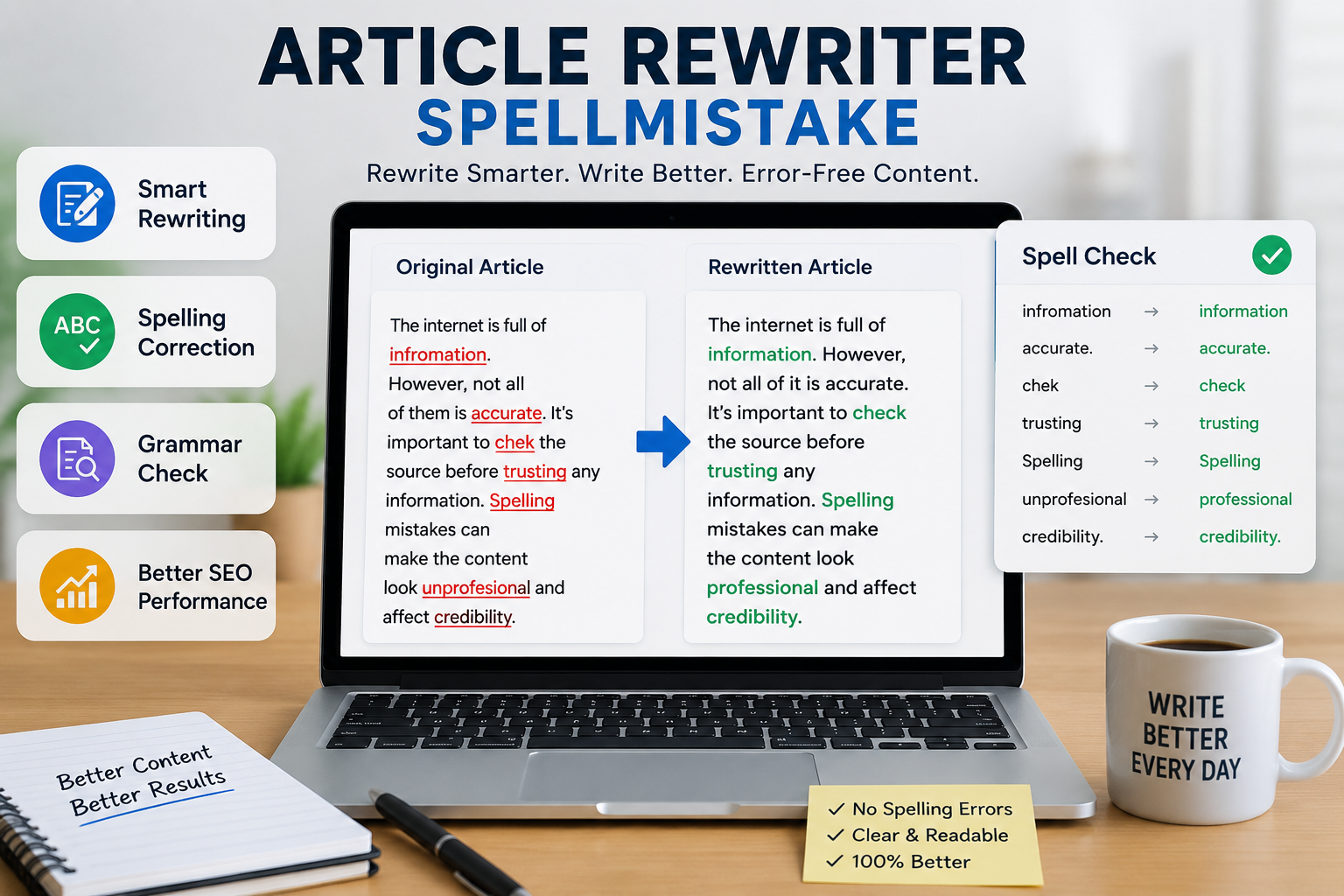
The internet produces an enormous amount of content every day. Blog posts, product descriptions, social media captions, research summaries, newsletters, and landing pages appear at a speed that would have been difficult to imagine years ago. Because of this demand, rewriting tools have become popular among students, marketers, bloggers, agencies, and website owners.
Many people search for article rewriter spellmistake because they want rewritten content without awkward grammar, strange wording, or obvious language errors. The concern is understandable. A rewritten paragraph that contains spelling issues or unnatural sentences can damage trust almost instantly.
Content quality is no longer judged only by keywords. Readers expect clarity, correct spelling, useful information, and a natural flow. Search engines have also become better at understanding content depth and overall usefulness. This means poor rewriting can hurt both user experience and visibility.
Rewriting itself is not a problem. In fact, rewriting is an important skill. Journalists rewrite facts into clearer narratives. Editors rewrite rough drafts into polished articles. Businesses rewrite technical information for customers. The issue begins when rewriting sacrifices meaning, readability, or accuracy.
Why article rewriter spellmistake Searches Are Becoming More Common
The rise of AI writing platforms and automatic paraphrasing tools has changed how people create content. Years ago, rewriting usually involved a human editor. Today, many users rely on software to transform existing text into something new.
The phrase article rewriter spellmistake often appears when users experience disappointing results after using automated tools. Instead of improving content, some systems generate awkward synonyms, broken sentence structures, or incorrect spellings.
There are several reasons behind this growing concern.
First, many rewriting tools prioritize speed over context. Replacing words without understanding meaning can produce confusing output. For example, changing simple vocabulary into uncommon alternatives may make a sentence harder to read rather than better.
Second, language has nuance. One word can carry multiple meanings depending on tone and situation. Automatic systems sometimes miss those differences.
Third, multilingual users often rewrite content in English even when English is not their first language. Small spelling mistakes become more likely during editing or translation.
Finally, low-quality rewritten articles may appear unique on the surface but fail to deliver genuine value. Readers notice this quickly.
As content competition increases, audiences reward authenticity and clarity. That makes accurate rewriting more important than ever.
The Difference Between Rewriting and Poor Paraphrasing
People often treat rewriting and paraphrasing as identical processes, but they are not always the same.
Good rewriting improves readability, updates structure, simplifies language, or adapts information for a new audience while preserving meaning.
Poor paraphrasing changes words mechanically without protecting the original idea.
Imagine a sentence:
"Healthy sleep improves concentration and emotional stability."
Weak rewriting might become:
"Proper resting develops focus and mood steadiness."
The meaning survives partially, but the sentence feels unnatural.
Strong rewriting could become:
"Consistent sleep helps people think clearly and manage emotions more effectively."
The second version remains human, clear, and informative.
Effective rewriting depends on understanding, not replacement.
Why Spelling Accuracy Influences Trust
Spelling errors seem small, yet they have a large effect on credibility.
Readers unconsciously associate clean writing with professionalism. Whether someone runs an online store, a blog, or a service website, mistakes can reduce confidence.
Consider two situations:
A financial website contains repeated spelling problems.
A medical article includes incorrect terminology.
In both cases, users may question the reliability of the information itself.
This reaction is natural. If visible details appear careless, audiences wonder whether hidden details are careless too.
Businesses spend significant resources building trust through branding and design. Poor writing can weaken those efforts in seconds.
How Search Engines Interpret Content Quality
Modern search systems evaluate more than keyword presence.
They increasingly consider usefulness, depth, topical relevance, readability, and user satisfaction. Articles overloaded with unnatural wording may struggle to perform well over time.
Thin rewritten content often shows patterns such as:
Very repetitive phrases
Odd sentence structures
Limited original insight
Weak transitions between ideas
Low informational value
Search visibility depends heavily on whether content actually helps readers.
An article written clearly for humans generally performs better than one written only for algorithmic goals.
How an article rewriter spellmistake Can Affect Content Performance
A single error may not destroy an article, but repeated issues create larger problems. The expression article rewriter spellmistake reflects concerns about quality loss during automated editing processes.
The impact can appear in several ways.
Reader engagement may decrease because confusing wording interrupts flow.
Bounce rates can increase when users leave quickly after encountering poor readability.
Brand reputation may weaken if audiences associate errors with low standards.
Educational content becomes less effective because meaning gets distorted.
Commercial content may lose conversions when trust declines.
These effects accumulate over time. A website with consistently weak content may struggle to build authority even with strong marketing efforts.
The Human Element in Rewriting
Technology can speed up drafting, but human review remains valuable.
Editors notice emotional tone.
Writers recognize audience expectations.
Experts detect factual inconsistencies.
Humans understand context better than simple replacement systems.
This does not mean automated tools are useless. Many are helpful for brainstorming, restructuring, or generating alternatives. The strongest results usually come from combining technology with thoughtful editing.
A practical workflow often looks like this:
Create initial content.
Use rewriting assistance carefully.
Review for meaning and clarity.
Correct grammar and spelling.
Improve transitions.
Add original insight.
Publish only after final reading.
The review stage is where quality often improves dramatically.
Common Causes of Rewriting Errors
Errors rarely happen for one reason alone.
Sometimes the source text is already weak. Rewriting poor material often produces another weak version.
Sometimes users request extreme uniqueness percentages, causing unnatural changes.
Other times, editing happens too quickly.
Several common causes include:
Lack of contextual understanding
Overuse of synonyms
Weak grammar models
Missing proofreading steps
Translation interference
Rushed publishing schedules
Recognizing these causes helps reduce future problems.
Using article rewriter spellmistake Tools Without Losing Natural Flow
The challenge with article rewriter spellmistake tools is not merely spelling accuracy. The larger issue is preserving meaning while sounding natural.
Natural writing has rhythm.
Sentences vary in length.
Ideas connect logically.
Examples support explanations.
Human expression rarely feels mechanical.
When rewritten content loses these characteristics, readers notice even if grammar appears correct.
The best approach is to treat rewriting systems as assistants rather than replacements for judgment.
Originality Does Not Mean Random Word Changes
Many content creators worry about uniqueness scores.
As a result, they push text through aggressive rewriting systems hoping for higher originality percentages.
True originality works differently.
Originality comes from:
Fresh interpretation
Personal experience
Unique examples
Clear explanations
Updated information
Thoughtful analysis
Changing vocabulary alone does not create new value.
A well-researched article with original insight usually feels more authentic than heavily altered text with little meaning.
Editing Habits That Improve Rewritten Articles
Strong editing habits often matter more than software choice.
Reading content aloud helps identify awkward phrases.
Taking short breaks before reviewing improves error detection.
Checking facts separately prevents misinformation.
Simplifying complex sentences increases readability.
Removing unnecessary words strengthens clarity.
These habits require effort but significantly improve outcomes.
Many professional writers spend considerable time editing after drafting.
Writing and polishing are different skills.
Choosing Better Alternatives to article rewriter spellmistake Tools
The phrase article rewriter spellmistake often suggests frustration with unreliable outputs. Instead of depending entirely on automatic rewriting, content creators can build stronger systems.
Better alternatives include combining manual editing with supportive technology.
Writers can also focus on learning core skills:
Sentence structure
Grammar awareness
Topic research
Audience understanding
Narrative flow
Clear explanations
Improving these fundamentals produces long-term benefits beyond any single tool.
The strongest writers are not always the fastest. Often, they are simply more attentive.
Why Content Depth Matters in Modern Publishing
Readers increasingly seek answers rather than surface-level summaries.
An article that repeats generic ideas without explanation may struggle to retain attention.
Depth means exploring causes, implications, examples, and context.
For instance, discussing rewriting quality becomes more useful when examining trust, SEO performance, readability, and communication impact together.
Depth creates value.
Value encourages sharing.
Sharing increases visibility.
The cycle benefits both readers and publishers.
The Future of Rewriting Technology
Language technology continues evolving rapidly.
Future systems may become better at understanding intent, tone, and audience expectations. Spelling correction and contextual editing are already improving.
However, even advanced systems will likely require human oversight in important fields such as healthcare, law, education, and finance.
Communication carries responsibility.
Accurate wording matters.
Meaning matters.
Context matters.
Technology may accelerate writing, but judgment remains essential.
Article Rewriting in 30 Seconds: The Short Answer
Short answer: An article rewriter changes the wording of a text while trying to keep its meaning. Good rewriting keeps facts, names, and numbers exactly right and makes the text easier to read. Bad rewriting swaps words without understanding them, so the meaning drifts and the text sounds unnatural. The difference is accuracy, not speed.
Want content that ranks — and links that support it?
Rewriting alone will not rank a page. It needs strong, relevant links behind it. AuthorityLinksPro, led by Olivia Gold, builds quality DoFollow links and guest posts that give good content the authority to rank. See our SEO services or message us on WhatsApp (+92 315 7528035) for a quick chat about your goals.
Rewriting, Copying, and Editing: What Is the Difference?
| Approach | What changes | What stays the same |
|---|---|---|
| Rewriting | The wording and sentence structure | The meaning, facts, and main points |
| Copying | Nothing, or almost nothing | The original text, word for word |
| Editing | Grammar, clarity, and flow | Most of the original wording |
How to Check a Rewrite Before You Publish It
- Read the rewrite aloud and listen for sentences that sound unnatural.
- Compare facts, names, and numbers with the original, line by line.
- Check quotes, links, and examples to make sure they still make sense.
- Remove any sentence that adds nothing or changes the meaning.
- Do a final read for tone: it should sound like one person wrote it.

Related reading from AuthorityLinksPro: our URL encoder guide explains how small address mistakes break links, our page size checker guide looks at why speed matters, and our free SEO tools can help you check a site quickly.
People Also Ask
Can a rewriter change the meaning of my article by accident?
Yes, easily. A rewriter that swaps words without understanding the sentence can change a fact, soften a warning, or turn a clear claim into a vague one. The risk is highest with technical writing, names, numbers, and quotes. Always compare the rewrite with the original before you publish it.
Is rewritten content still original?
It can be, if the wording is genuinely new and the ideas are presented in your own way. Simply changing a few words in someone else's article is not original writing, and it will not fool readers or search engines for long. Use rewriting to improve your own text, not to disguise someone else's work.
How do I check a rewrite before I publish it?
Read the rewrite on its own first, without the original beside you, and mark anything that sounds wrong or unclear. Then compare it with the original, checking facts, names, numbers, and quotes one by one. If a sentence only makes sense with the original in front of you, rewrite that sentence again.
Should I rewrite an article myself or use a tool?
Use a tool for a first draft if it saves you time, but do the final rewrite yourself. Tools are good at changing words quickly, while you are better at judging tone, accuracy, and what your reader actually needs. A careful human pass is what turns a rewritten draft into an article worth publishing.
Does rewriting an old article help it rank better?
It can help, if the rewrite makes the article clearer, more accurate, and more useful than before. Updating old facts, improving the structure, and adding honest detail give search engines a reason to show it again. Rewriting the same weak article with different words, and changing nothing else, will not move it on its own.
Ready to give your content the links it deserves?
Tell AuthorityLinksPro what you want to rank for and we will plan the links with you. Start with our SEO services or reach us on WhatsApp — we reply personally.
Conclusion
The conversation around rewriting tools is larger than grammar checks or typo corrections. It touches trust, communication quality, originality, and long-term credibility.
Ultimately, article rewriter spellmistake reflects a broader concern: people want rewritten content that remains accurate, useful, readable, and genuinely human. As online publishing grows, careful editing and thoughtful rewriting will continue separating valuable content from forgettable text.